Importance of Sea Turtles to Marine Ecosystems
Sea Turtles are critical to the biodiversity of the Ocean and are major contributors to healthy ecosystems.
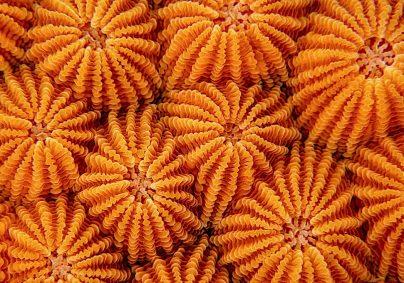
Among their many ecological benefits, sea turtles help to keep the Coral Reef ecosystem healthy and productive while also playing an important role in maintaining a balanced marine food web, making them a key species in ocean conservation.
Because of their wide movements across the ocean, sea turtles are also important indicators of ocean health. A decline in turtle populations often reflects larger environmental problems such as habitat loss, pollution, overfishing, and climate change.
Sea Turtle Population Decline
We are now witnessing the consequences of a world with fewer sea turtles—our oceans are changing, and not for the better. As sea turtle populations continue to decline worldwide, the delicate balance of marine ecosystems is being disrupted, putting the health of our reefs, seagrass beds, and entire ocean food webs at risk.
As responsible Marine Protectors and Ocean Ambassadors, it is important to understand the role Sea Turtles have in maintaining healthy marine and terrestrial ecosystems. Protecting sea turtles means protecting the health, biodiversity, and future of our oceans.
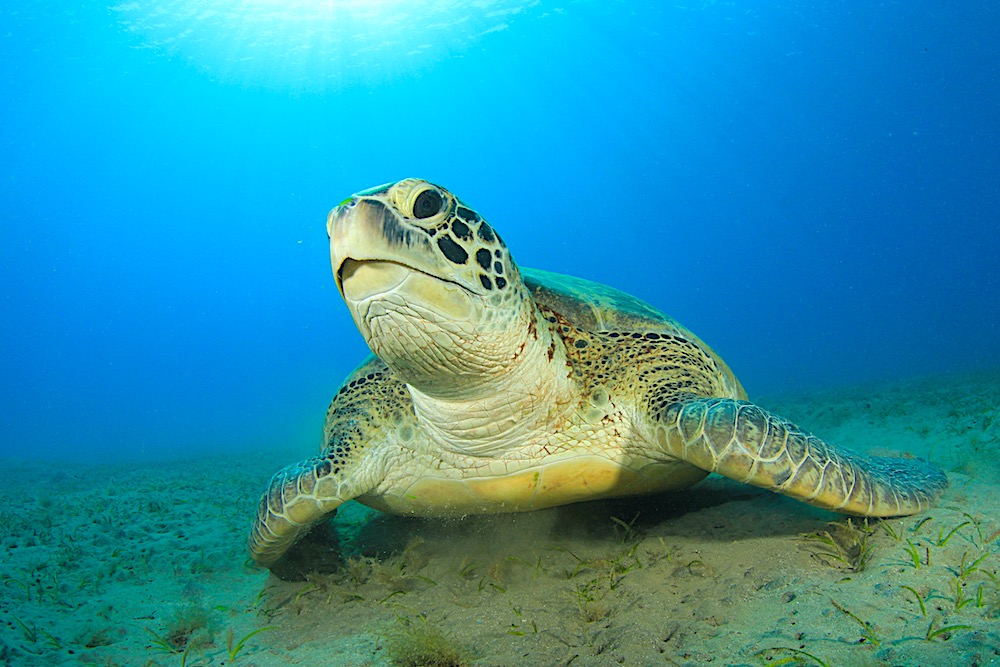
Green Sea Turtles – Keeping Seagrass Beds Healthy
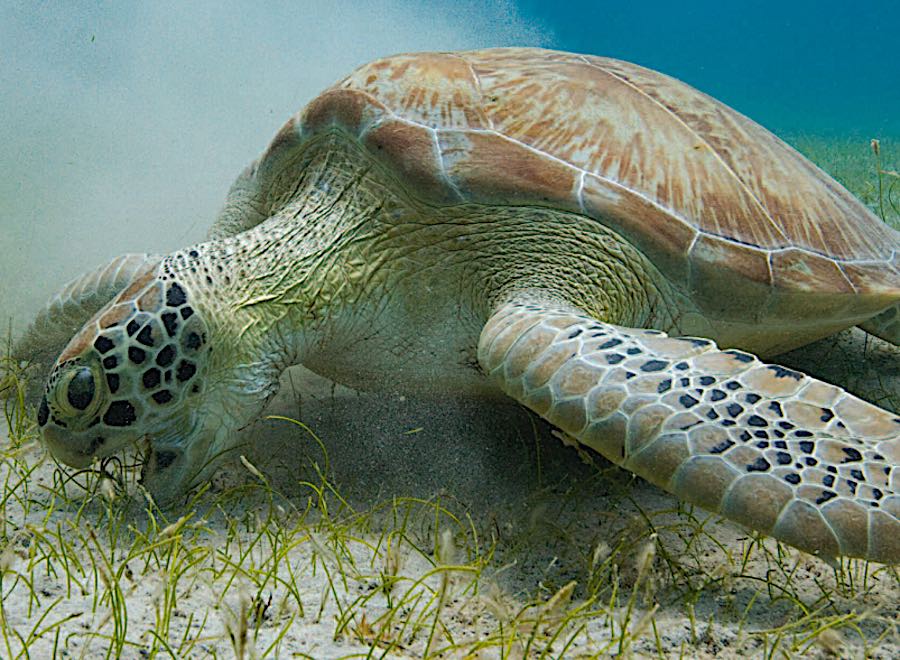
Green sea turtles are one of the few large marine herbivores that graze on seagrass. Their regular feeding helps keep seagrass short, healthy, and productive by increasing nutrient content and encouraging new growth.
When green sea turtle populations decline, seagrass beds can become overgrown and unhealthy. Thick, unmanaged seagrass slows ocean currents and reduces the amount of sunlight reaching the seabed.
This leads to increased decomposition, encouraging the growth of slime mold and causing the seabed to become overpopulated with algae, fungi, microorganisms, and invertebrates, ultimately disrupting the balance of the entire ecosystem.
Green sea turtles prefer to graze on the fresh, younger parts of seagrass blades, feeding just a few centimetres above the base of the plant. This natural grazing keeps seagrass beds healthy and well-maintained, while the older upper sections float away instead of accumulating on the seabed.
Scientists have found that this process helps regulate nutrient cycling, particularly by influencing nitrogen availability around seagrass roots. This supports healthier plant growth, greater biodiversity, increased marine life density, and balanced predator-prey relationships—all of which contribute to a stronger and more productive ecosystem.
Here on Koh Tao, green sea turtles have adapted their diet to match the food sources available within the island’s surrounding bays and reefs. As large seagrass meadows are not available food source, they primarily feed on macroalgae, using their strong serrated jaws to graze algae from rocks, coral rubble, and reef surfaces. This natural grazing helps prevent algae from overgrowing and competing with corals for space, ultimately supporting healthier and more balanced reef ecosystems.
Young green sea turtles begin life as opportunistic omnivores. During their juvenile stage, they feed on a variety of small marine organisms such as fish, crabs, worms, jellyfish, and algae, taking advantage of whatever food is available as they grow.
As they mature, usually once they reach around 8–10 inches in shell length, their diet begins to change. They develop strong, serrated jaws specially adapted for grazing, allowing them to shift to a mostly herbivorous lifestyle.
However, f food sources are limited, they can occasionally behave as opportunistic omnivores. Seen to consume small amounts of animal-based prey such as sponges, jellyfish, sea cucumbers and soft corals. This flexible diet helps them adapt to different habitats and changing environmental conditions.
Green Sea Turtle Identification & Behaviour
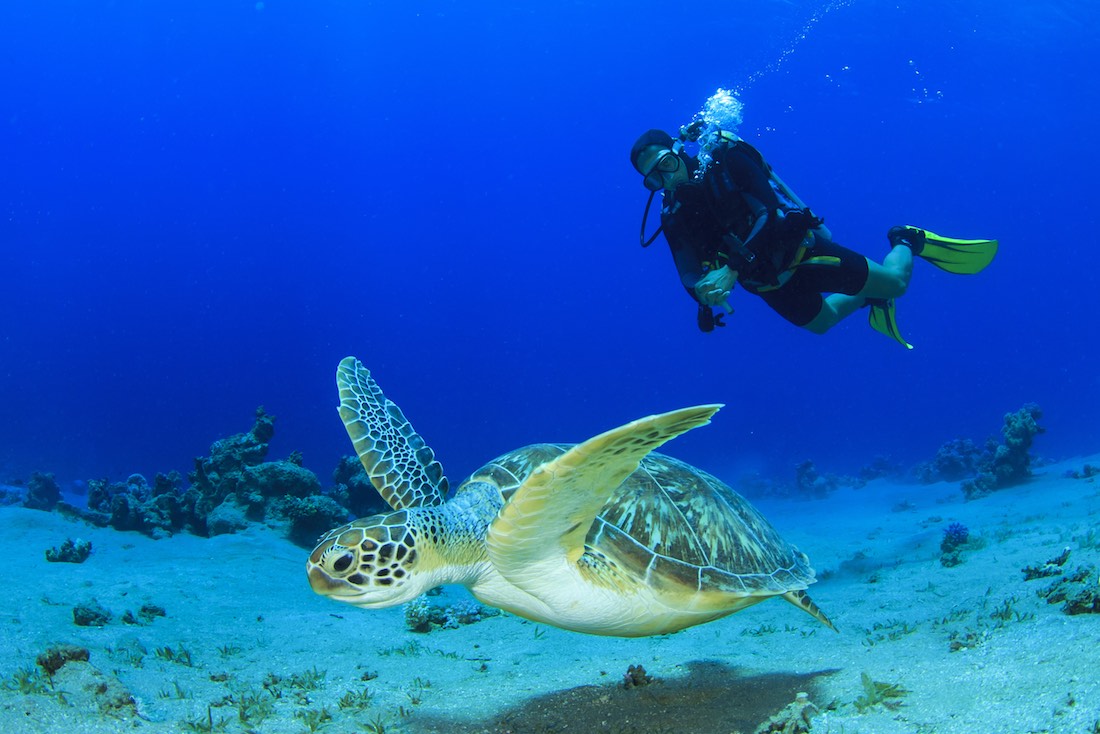
Green sea turtles are one of the most commonly encountered sea turtle species around Koh Tao and can be identified by several distinct features.
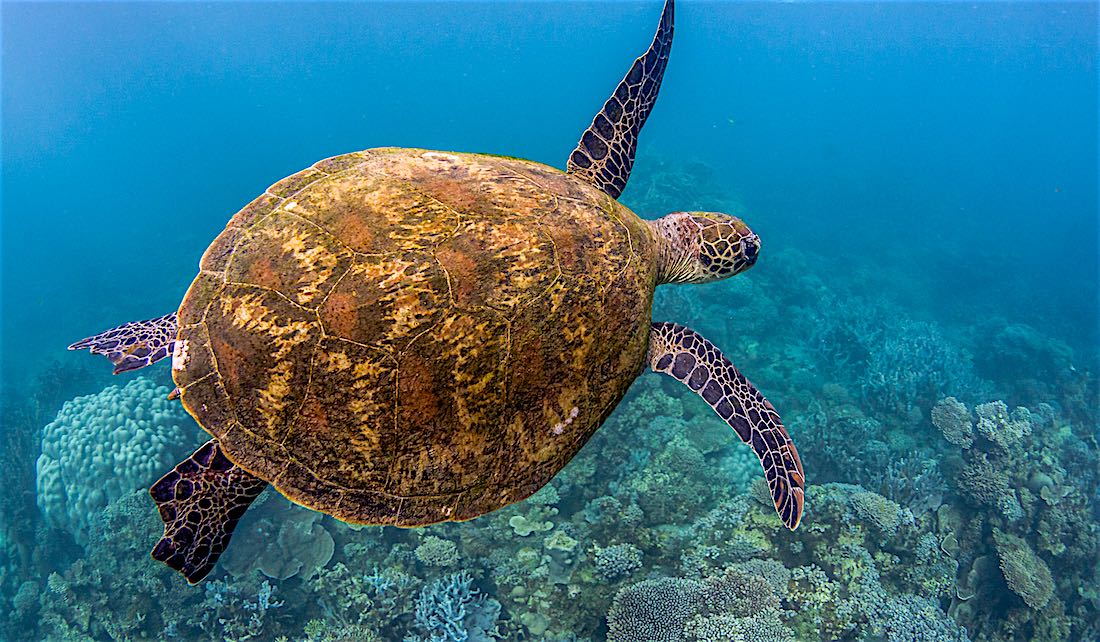
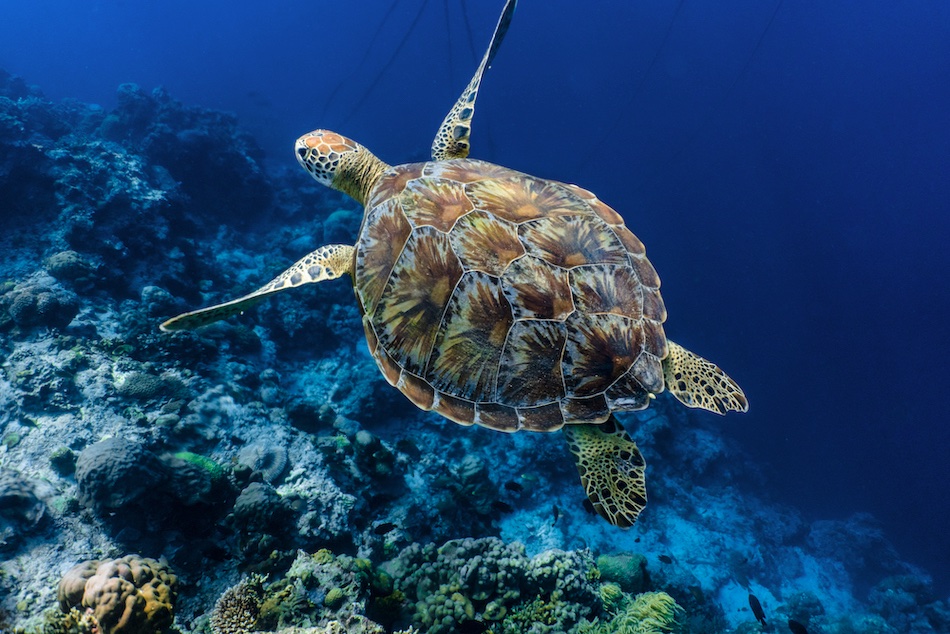
Despite their name, the “green” refers to the colour of their body fat rather than their shell. Their carapace (shell) is usually smooth, oval-shaped and scalloped around the edges, with shades of brown, olive and dark mottled patterns that help them blend into reef environments.
They have a relatively small, rounded head with a single pair of scales in front of the eyes, and unlike hawksbill turtles, their beak is short and not sharply hooked.
Adult green sea turtles grow to be the second largest of all sea turtle species, with their size ranging from 0.9 to 1.5 meters in shell length and weighing between 135–225 kg. Juveniles are smaller and may display slightly brighter shell patterns.
Green sea turtles are generally calm, slow-moving, and often seen resting under coral ledges, cruising through shallow bays, or surfacing calmly for air. Around Koh Tao, they are frequently observed grazing on algae in sheltered bays.
Green turtles are also highly migratory and often return to the same feeding and nesting areas throughout their lives. Their behaviour can provide valuable information for conservation efforts, as changes in feeding patterns, movement, or health can indicate wider environmental issues affecting the reef ecosystem.
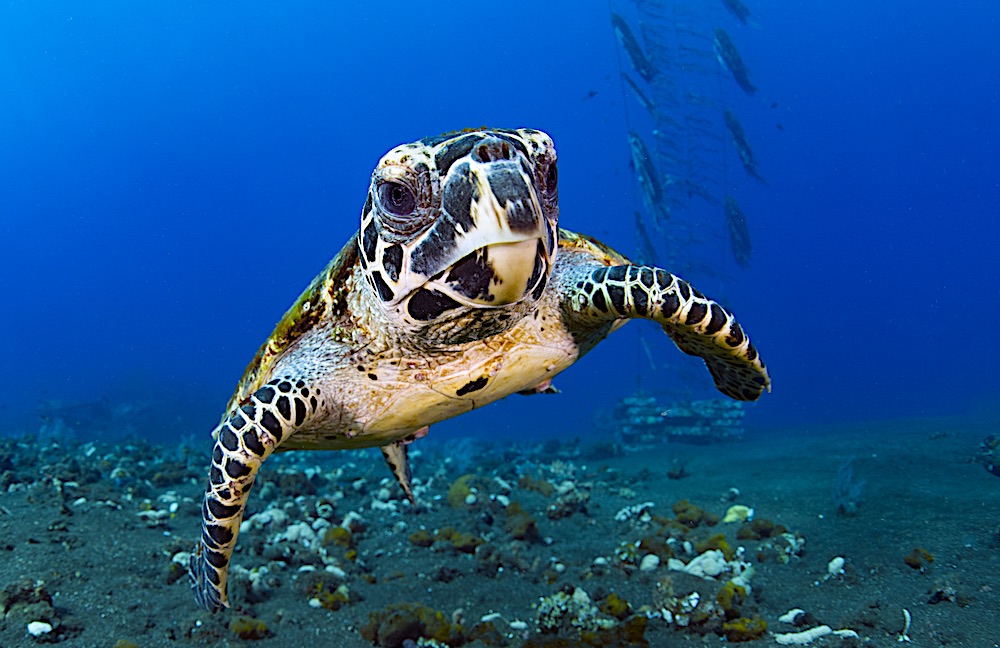
Hawksbill Sea Turtle – maintaining the Foundation of Coral Reefs
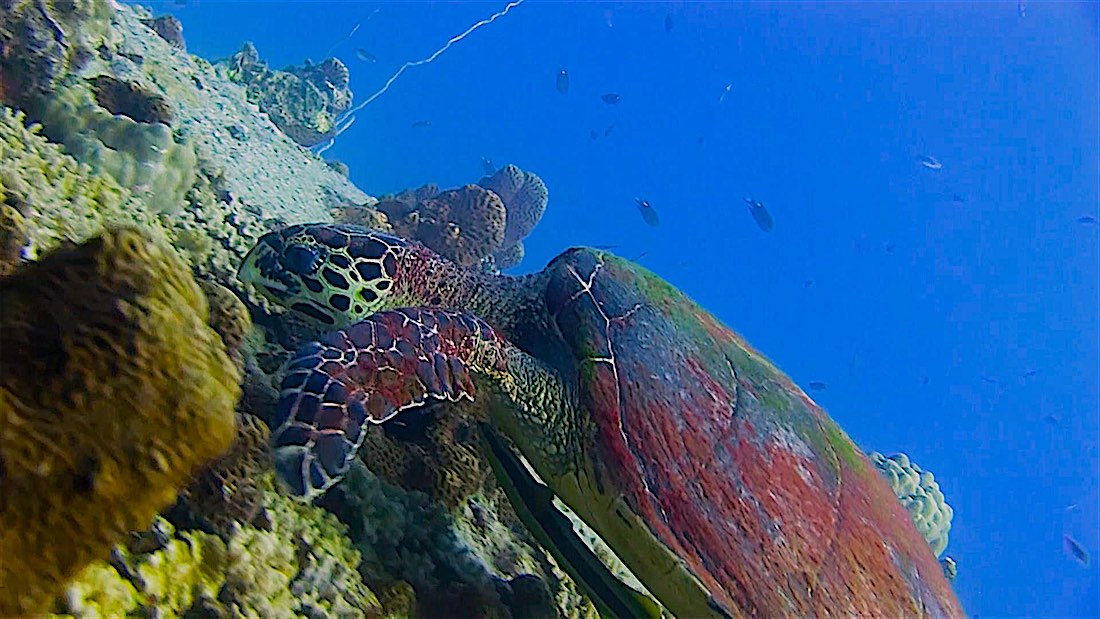
Hawksbill Sea Turtles are omnivorous, meaning they feed on both plants and animals, but their preferred and most important food source is sea sponges. Sea sponges can make up the majority of an adult hawksbill’s diet, making them one of the few marine animals specially adapted to feed on them.
Sea sponges have chemical defences and can also change their physical properties, which deters fish and other marine animals from eating them.
However, when a Hawksbill Sea Turtle eats a marine sponge, other species will eat parts of the sponge they usually cannot get too.
Sea sponges compete directly with reef-building corals for space, sunlight, and access to nutrients. Because sponges can grow quickly and spread across reef surfaces, they can easily dominate sections, preventing young corals from settling and reducing the overall diversity of the ecosystem.
Hawksbill turtles play a vital role in controlling this balance. By feeding on sponges, they help prevent sponge overgrowth and create more available space for corals to grow and thrive. This supports healthier, more resilient coral reefs that can provide shelter, breeding grounds, and feeding areas for countless other marine species.
If hawksbill turtle populations decline, sponge populations can rapidly increase and begin to outcompete corals, leading to major structural and ecological damage across the reef. Over time, this can reduce biodiversity, weaken reef resilience, and impact the many species—including humans—that depend on healthy coral reef systems.
Hawksbill Sea Turtle Identification & Behaviour
Hawksbill sea turtles are one of the most distinctive sea turtle species found on coral reefs.
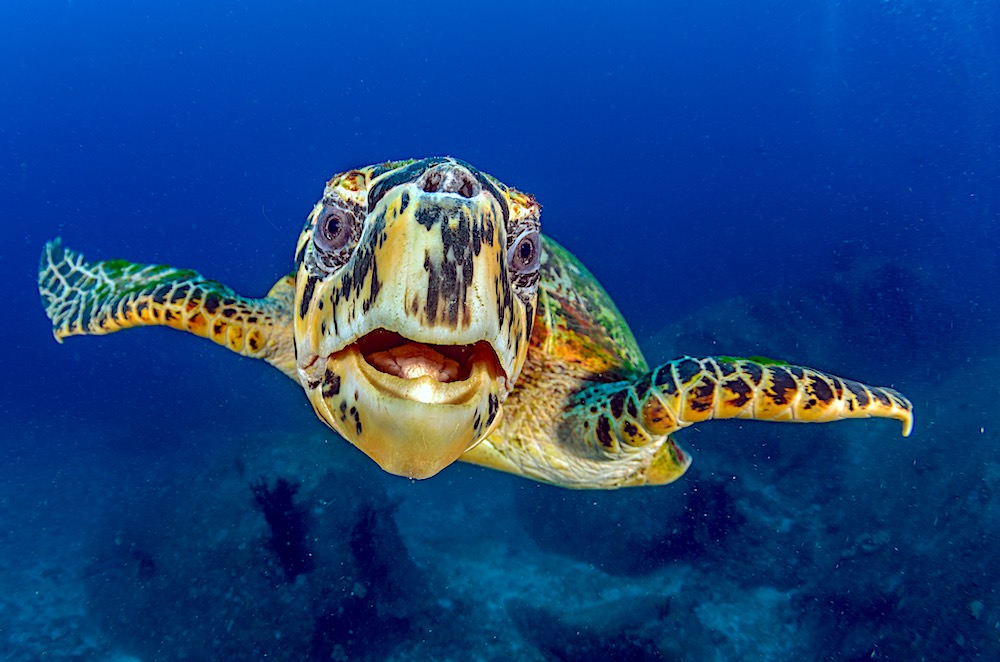
Their name “hawksbill” comes from this narrow, pointed beak, which is perfectly adapted for reaching into small crevices in the reef to extract food such as sea sponges, soft corals, and small invertebrates.
Their carapace is oval-shaped with overlapping scutes, giving the edges a slightly serrated or saw-like appearance. The shell often displays striking amber, brown, yellow, and black patterns, making them one of the most visually recognisable turtle species. Unlike green turtles, hawksbills have two pairs of scales between their eyes (prefrontal scales), which is a key identification feature.
Hawksbill turtles are generally smaller than green sea turtles, usually growing up to around 90 cm in shell length and weighing between 45–70 kilograms. They are agile swimmers and are most often found around coral reefs rather than open seagrass areas.
Hawksbills are often more solitary and secretive than green turtles. They are commonly seen weaving through reef structures, resting beneath coral overhangs, or foraging carefully around sponges and crevices.
They are also known for strong site fidelity, often returning to the same feeding grounds and nesting beaches throughout their lives. Observing their behaviour can provide valuable insight into reef health, habitat quality, and the overall condition of marine ecosystems.
Nesting Sea Turtles – Sand Dune Ecosystems
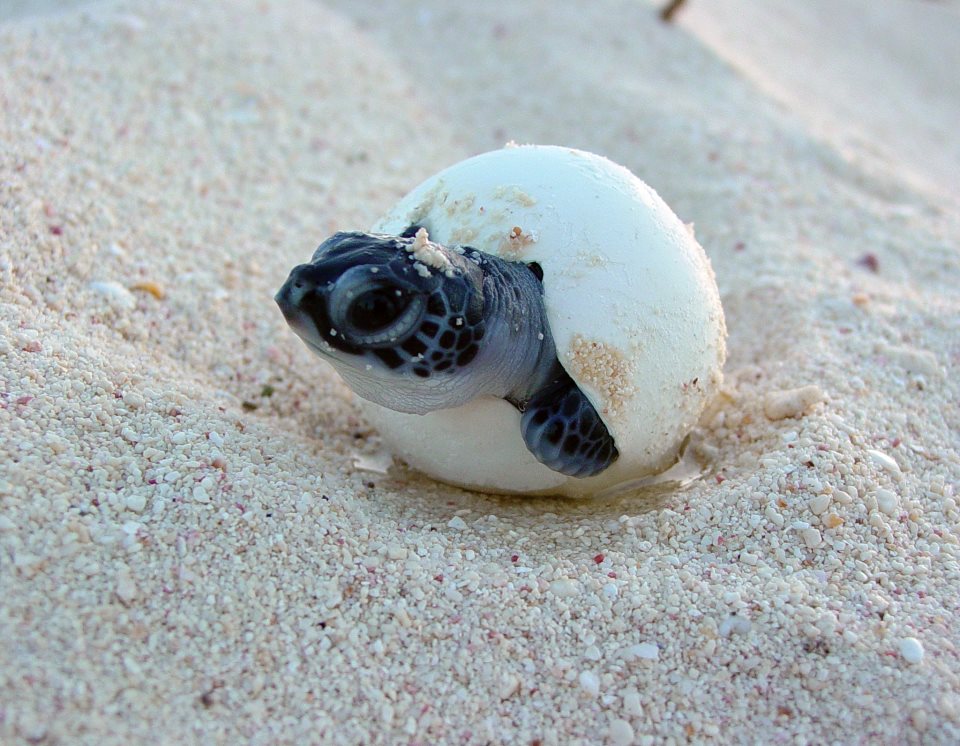
Nesting Sea Turtles provide a concentrated and much needed source of high-quality nutrients to sand dune ecosystems.
Sea Turtle eggs provide vital nutrients such as nitrogen, phosphorus and potassium that soak into the beach dune ecosystems.
If the eggs hatch, nutrients are left behind in the eggshell and embryonic fluid.
Nesting Sea Turtles Species Distribution
If the eggs do not hatch, even more nutrients will enter the food chain with plants absorbing some nutrients and others dispersed to small organisms that live in the sand.
This helps sustain the growth of various plants and vegetation, stabilizes the shoreline, including their nesting habitats and provides food for a variety of herbivores.
This also leads to nesting Sea Turtles influencing species distribution. Sea Turtles play an important part in maintaining the food web balance.
Leatherback Sea Turtle – Jellyfish Predator
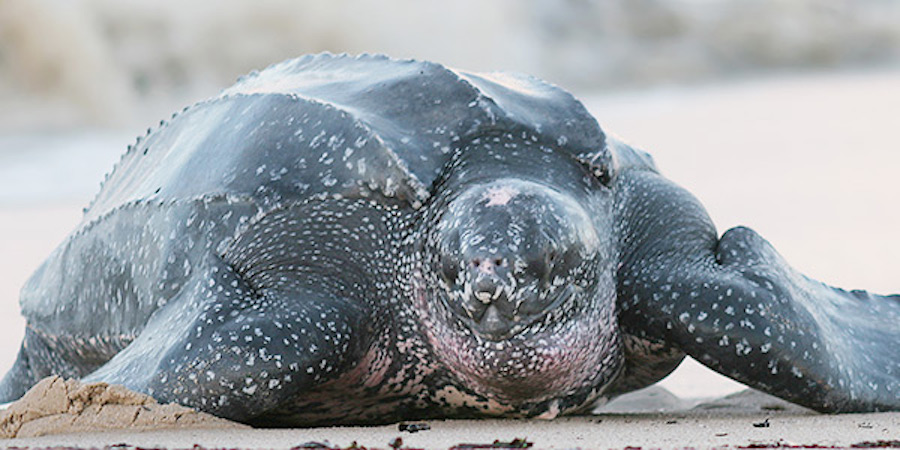
The largest Sea Turtle is the Leatherback and they travel further than any of the other species of Sea Turtles, grow over 2 meters in length and can weigh up to 700kg. Leatherback Sea Turtles, somewhat surprisingly eat Jellyfish and they consume large amounts daily to maintain a healthy diet.
A Leatherback Sea Turtle has been known to consume 200kg of Jellyfish a day and this huge appetite also plays an important role in balancing the ecosystem. Leatherback Sea Turtles migrate across entire Oceans and as they consume significant amounts of Jellyfish, they play an important role as one of the top jellyfish predators.
Leatherback Sea Turtle Identification & Behaviour
A declining Leatherback Sea Turtle population means an increase in the jellyfish population.
This is a serious concern and when combined with declining fish stocks caused by overfishing, has seen a proliferation of Jellyfish across the world.
Less fish means less competition for food and as Jellyfish prey on fish eggs and larvae, this also impedes recovery of fish stocks.
Unfortunately, a continuing decline in the population of Leatherback Sea Turtles has seen further shifts in species dominance from fish to jellyfish.
Sea Turtles provide Habitat and Food
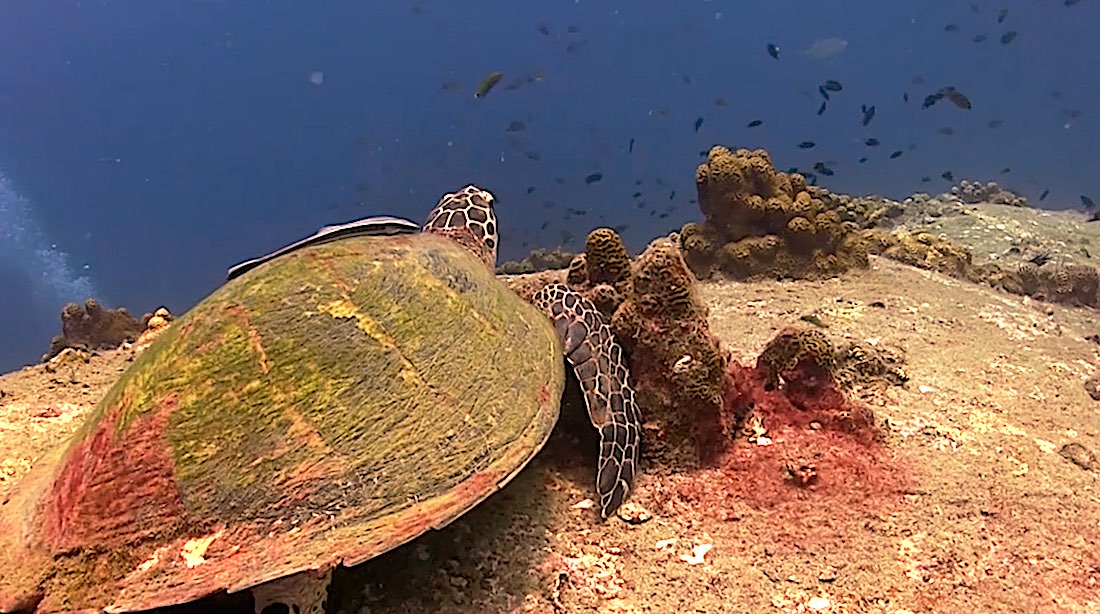
Sea turtles are almost like small ecosystems in themselves, providing both habitat and food for a wide variety of marine life. Their shells create a living surface where many different organisms can settle and grow, forming important symbiotic relationships within the ocean.
More than 100 different species of epibionts—organisms that live on the surface of another animal—have been identified on loggerhead sea turtle shells. These include barnacles, algae, small crustaceans, and other marine life that attach themselves to the turtle’s shell and skin.
These epibionts not only benefit from transportation and access to new environments, but they also create feeding opportunities for other reef animals. Small fish and shrimp are often seen picking at the algae and barnacles on turtles, using them as an important food source.
In this way, sea turtles support marine biodiversity far beyond their own survival, helping sustain the complex web of life that keeps reef ecosystems healthy and balanced.
Sea Turtles & Epibionts
Cleaner wrasse and cleaner shrimp create cleaning stations that sea turtles regularly visit. These small animals remove algae, parasites, and dead skin from the turtle’s shell and body, benefiting both species—the cleaners gain food, while the turtle gets a “shell and skin clean” that helps reduce drag and improves health.
Some wrasse species are even specialised to feed on specific barnacles found on green sea turtle shells. It is also common to see remora sucker fish travelling alongside larger sea turtles, using them for protection and feeding opportunities.
Sea Turtles & Symbiotic Relationships
Remora fish feed on parasites such as copepods that attach to sea turtle shells, along with dead skin the turtle sheds and small scraps of leftover food. This creates a mutually beneficial relationship—the remora gains food, transport, and protection from predators, while the sea turtle benefits from reduced parasites and a cleaner shell.
As sea turtle populations continue to decline, species like remoras, cleaner fish, and cleaner shrimp lose an important part of their survival strategy and are often forced to find less effective ways to feed and protect themselves.
Sea Turtles distribute Marine Diversity across the Worlds Oceans
During their lifetime, sea turtles travel thousands of miles across oceans and seas, often migrating between feeding grounds, breeding areas, and nesting beaches.
These long-distance journeys make them far more than just travelers—they act as important carriers of marine life and help connect ecosystems across vast distances.
Sea Turtle Migrations
As sea turtles move through different habitats, many small organisms travel with them. Barnacles, algae, small crustaceans, and other epibionts attach themselves to the turtle’s shell and skin, using the turtle as both transport and habitat. This allows these species to spread between reefs, coastlines, and ocean regions they may never reach on their own.
Scientists believe this movement helps increase the distribution and genetic diversity of species such as barnacles, particularly those that depend on living hosts like loggerhead sea turtles. By carrying these organisms across huge distances, sea turtles help maintain healthy gene flow between populations and support biodiversity throughout the ocean.
Why are Sea Turtles an Endangered Species?
Worldwide numbers of Sea Turtles have decreased dramatically over the last 200 years and this decline in species population is increasing.
Six of the seven species of Sea Turtles are classified as threatened or endangered due to human actions.
Around Koh Tao, two species are commonly found—the green sea turtle and the hawksbill sea turtle. While both face serious threats, the hawksbill sea turtle is listed as critically endangered, making its protection especially important.
What Significant Threats are Sea Turtles facing?
The International Union for Conservation of Nature (IUCN) has identified the five most significant threats to the Sea Turtle’s existence.
1. Commercial Fishing and Bycatch
Sea Turtles are accidentally caught or entangled in commercial fishing nets, which is often fatal as Sea Turtles breathe air and need to surface at regular intervals. If they become entangled, they will often drown.
Longline fishing is prone to the incidental catching and killing of Sea Turtles.
Modern fishing practices can also damage Sea Turtle habitat and severely impact the food web.
2. Direct take or illegal Fishing
Sadly, across our planet Sea Turtles are still illegally poached.
This is despite trade of all 7 species of Sea Turtle being banned by CITES (Convention on International Trade in Endangered Species of Wild Fauna & Flora)
Sea Turtles are poached and traded for their eggs, meat, skin and their shells.
For centuries Hawksbill Sea Turtles have been hunted for their beautiful gold and brown shells, which are used to create jewellery and other luxury items and is the main reason this species is critically endangered.
Unfortunately, many parts of the world lack the law enforcement necessary to police this, or due to corruption turn a blind eye at a practice that has been common for centuries within some communities.
There are still a few countries that allow the trade of Hawksbill Sea Turtles to continue today, citing cultural practices dating back 400 years.
3. Coastal Development
The huge increase in coastal development over the last 20-30 years has had a negative impact on Sea Turtle nesting habitats.
Increases in construction, tourism, boat traffic, dredging and other environmental impacts have all had a detrimental effect on the natural habitats Sea Turtles use for nesting.
Artificial light from coastal infrastructure such as hotels pose another threat to nesting turtles.
The lights can cause disorientation with young hatchlings not finding their way to the Ocean and discourage females from nesting at all.
4. Pollution
Ocean trash is a huge problem now with the ICCUN estimating approximately 8 million tons of plastic enters our Oceans annually.
Plastics, petroleum by-products and discarded fishing equipment make up a large percentage of deadly marine debris that can hurt or kill Sea Turtles who ingest or become entangled.
Jellyfish and sea sponges form a major part of the diet of some species of Sea Turtles and sadly, Sea Turtles can mistake plastic for jellyfish and other general marine debris as a food source.
Key 2025–2026 Statistics and Findings
- Nearly 50% of studied sea turtles were found to have ingested plastic.
- Researchers found that, on average, as little as two baseballs’ worth of soft or hard plastic can be enough to kill a sea turtle.
- Green sea turtles are particularly vulnerable, with some studies showing that up to 62% have ingested plastic, often mistaking it for algae or other food sources.
- Loggerhead turtles are also heavily affected, with similar studies reporting ingestion rates of around 17%.
- Soft plastics such as plastic bags, along with lost fishing gear, are considered some of the most dangerous forms of marine debris.
- Microplastics on nesting beaches can also affect hatchling survival by changing sand temperatures, which can influence both hatchling development and gender ratios.
5. Climate Change
The temperature of a Sea Turtle egg during the incubation period can determine the sex of the Sea Turtles off-spring.
Warming air temperature means warmer water and sand temperature and this rising temperature results in fewer male hatchlings and disrupts efficient reproduction patterns.
Rising global temperatures have also seen an increase in storms that can destroy the reef that some Sea Turtles live on, or the beaches they nest at.
As the frequency of extreme weather events increases, critical Sea Turtle habitats and normal Oceanographic processes will be seriously disrupted or even destroyed.
What can you do to help Sea Turtles?
There are many ways you can help the plight of Sea Turtles and we offer a few easy ways that you can start with right away.
Make smart seafood choices
- Ask where and how your seafood was caught. Only buy seafood from responsible fishing operations that use fishing techniques that do not harm or kill Sea Turtles.
Educate friends and family about sustainable fishing practices
- Share your knowledge about the plight of Sea Turtles and the devastating effects modern commercial fishing techniques have on the Ocean environment and the health of Sea Turtles.
Limit your use of plastic and try and eliminate using Single Use Plastic
- Carry reusable water bottles and switch plastic shopping bags to a reusable cloth bag.
- If you order takeaway, provide the restaurant with reusable containers and support restaurants and businesses that support eliminating single use plastics in their business activities.
- Stop using single use plastics when there are reusable alternatives and replace plastic with more eco-friendly options.
Participate in Dive Against Debris dives, Beach Clean Ups and Microplastic surveys
- Get wet! Sign up for the next Dive Against Debris and help clean up some marine trash in your local area and contribute to improving the health of our Ocean ecosystems.
- Through local volunteer efforts, this great citizen science program provides valuable information about marine debris that can help inform policy change.
- Alternatively, if conducting a beach clean up, the Cleanswell App allows you to record the type of trash you find on the Ocean Conservancy global Ocean trash database.
- The data delivers a global snapshot of Ocean trash, helping researchers and policy-makers to make inform decisions and solutions.
Support Sea Turtle Conservation and Get Involved
- The oldest Sea Turtle research and conservation organization is The Sea Turtle Conservancy.
- The STC’s mission is to ensure the survival of Sea Turtles in the Caribbean, Atlantic and Pacific through research, education, training, advocacy and protection of the natural habitats that they depend upon.
Other conservation organizations at the forefront of Sea Turtle conservation include the World Wildlife Fund and the Oceanic Society.
What can the world do to help Sea Turtles?
Despite decades of concern by scientists and conservationists about the plight of Sea Turtles and the threats they face, there is no international agreement that fully protects them.
Sea Turtles are highly migratory, travelling long and far across the worlds Oceans and this is at the heart of the problem. To truly protect Sea Turtles many countries and cultures must work together and cooperate.
This must include:
Increased capacity of National governments to Act
- National governments enforcing CITES regulations and strengthening their domestic legislation to restrict trade of Sea Turtles and Sea Turtle products.
- Improvements in investigating and enforcing the law in the market place is needed.
Enhanced regional cooperation between national governments
- Strengthen coordination and collaboration and promote information sharing on the illegal international trade, such as smuggling methods and trade flows between national governments.
- Existing agreements already include joint information sharing and capacity building initiatives.
- Build on these especially in areas where the migration patterns of Sea Turtles mean they are crossing multiple borders and entering different jurisdictions.
Raise awareness about the illegal Sea Turtle shell trade
- Despite all seven species of Sea Turtles listed as endangered in appendix I of the Convention on International Trade in Endangered Species of Wild Fauna and Flora (CITES) and prohibition of international commercial trade of Sea Turtles, Sea Turtles are still illegally poached.
- According to a study commissioned by the CITES Secretariat in November 2019 illegal trade in marine Sea Turtles continues.
- Although globally outlawed in 1977 the Bekko trade (tortoiseshell) continues on the black market.
- Illegal trade flows from South East Asia to countries such as China, Japan, Taiwan, Hong Kong and where there is a high demand for Bekko products.
- Investigations have also shown these outlawed Bekko products readily available in Latin America.
- The United States is the world’s second largest market for illegal wildlife products, with returning tourists unaware they are contributing to the decline of critically endangered species, bringing these products back from abroad.
- As the country most responsible for the worldwide trade in tortoiseshell over the past two centuries, Japan warrants consideration both for its historic role in the decline of Hawksbill Sea Turtle populations worldwide and its continued legal domestic trade.
- In Japan, the country most responsible for trade in tortoiseshell, it is still legal to sell tortoiseshell products domestically.
- We must educate and raise awareness among key players such as local communities, fishermen and traders in countries of origin and the consumers in countries where there is demand.
Are Sea Turtles facing Ecological Extinction?
As we have shown Sea Turtles play a very important part within Marine ecosystems. Travelling thousands of miles across Oceans, various species of Sea Turtles help maintain healthy sea grass beds, provide important nutrients to nesting dunes and ensure our Coral Reefs remain strong and healthy.
However, with populations declining rapidly and two Sea Turtle species, Kemp Ridley and Hawksbill Sea Turtle now critically endangered, there is a real danger that Sea Turtles are heading towards ecological extinction. This occurs when the number of Sea Turtles becomes too small to continue to contribute to its ecological role as a major contributor to the amazing diversity that our Oceans require to remain healthy.
Sea Turtle Awareness Course in Thailand
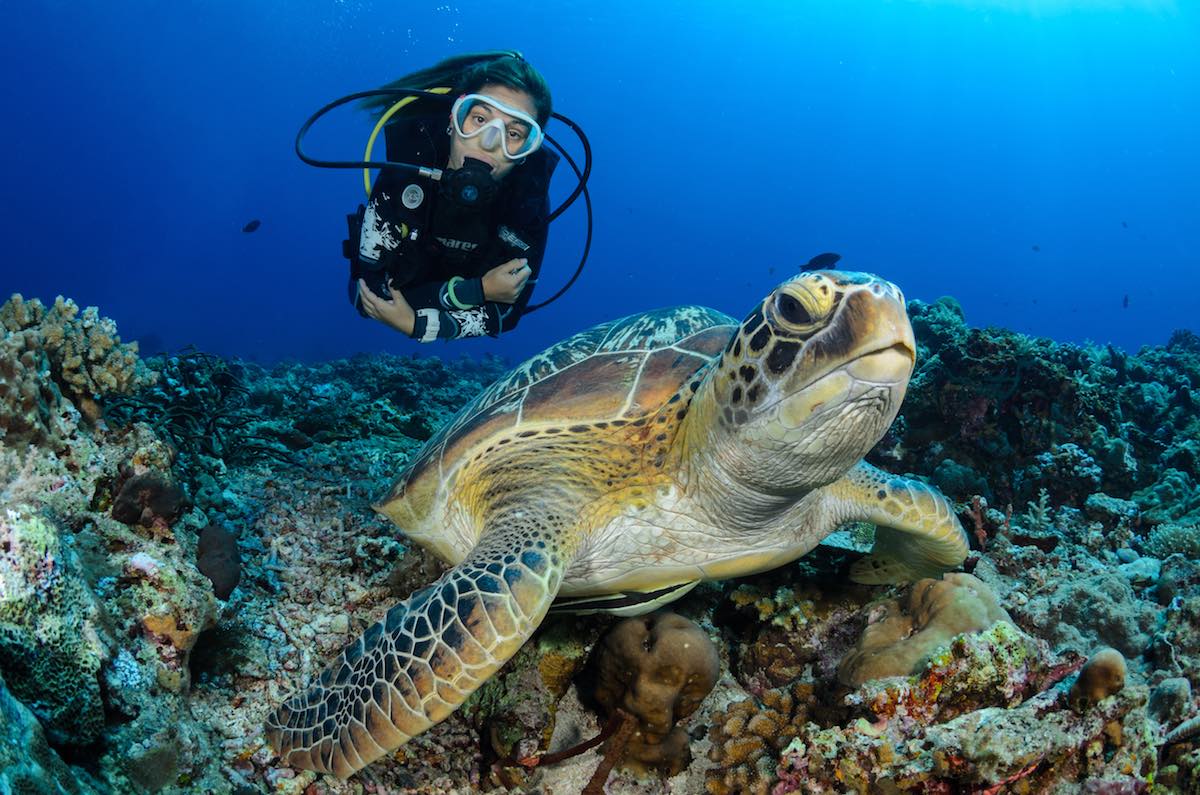
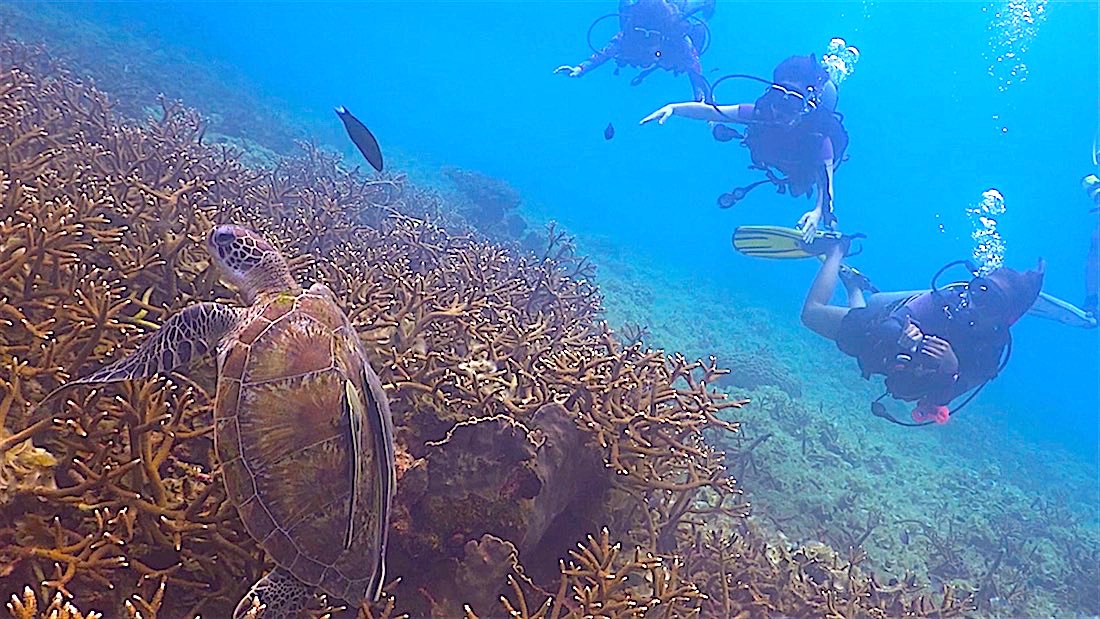
Hawksbill Sea Turtles and Green Sea Turtles are regular visitors to the warm, tropical sea surrounding Koh Tao and are quite often seen when scuba diving at many of the dive sites. Snorkel tours around the island provide visitors with another opportunity to see these magnificent marine inhabitants in their natural environment.
A local citizen science group – Koh Tao Turtles – has been monitoring the local Sea Turtle population for the last 10 years and tracks, monitors and helps to identify Sea Turtles to help conserve this iconic species.
Sea Turtle Marine Conservation Course
Black Turtle Dive team have been involved with local conservation efforts for 15 years and offer many marine and land-based conservation courses to visitors who want to get involved and learn how to protect and conserve the local environment.
The Sea Turtle Awareness one day foundational course is one such course that helps increase awareness of Koh Tao Sea Turtles and is available to anyone from 10 years of age.
The course can be conducted and completed with scuba diving or snorkeling at popular bays around Koh Tao where Sea Turtles are seen daily.
Sea Turtle Awareness Koh Tao
A morning session offers an introduction to the seven main species of Sea Turtles, educational handouts including a Sea Turtle Identification key and a 2-hour interactive presentation.
Afternoon practical sessions include either 2 Open Water scuba dives or snorkeling sessions as customers get to see Sea Turtles in their natural environment.
The Sea Turtle Awareness course concludes with a debriefing and feedback session on species identification, behaviour witnessed and guidelines on what we can all do more of to protect this amazing and endangered marine species.
To find out more please visit Sea Turtle Ecology & Monitoring to see how you can get involved in Sea Turtle Conservation.
Written by Matt Bolton
Founder @ Black Turtle Dive | Co-Founder – Eco Koh Tao & Isla Tortuga Divers | PADI Platinum Course Director @ IDC Koh Tao | Dive Industry Consultant | Marine Conservation Pioneer
10 Interesting Facts about Koh Tao Dive Sites
What is Coral bleaching and what causes it
BOOK COURSES – PRICES